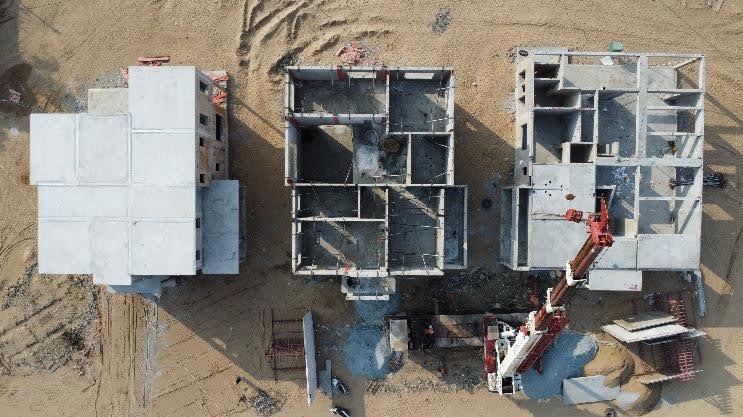
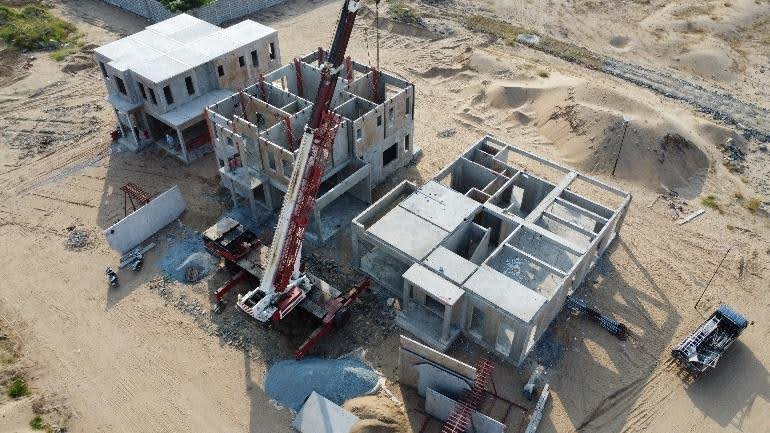
In Vietnam’s housing future, sustainability will define success. While speed creates opportunity and quality builds trust, only sustainability ensures long-term growth and resilience. Pilot projects have already proven that Fully Precast / Total Precast systems, or PCBS (Precast Concrete Building System), can deliver homes faster and with higher quality. The real challenge now is scaling these solutions into a nationwide program capable of meeting Vietnam’s ambitious housing target of 1 million affordable units by 2030.
Sustainability as the third pillar
Sustainability in housing must be understood in three interconnected dimensions:
- Economic sustainability: Cost control through standardized PCBS modules, reusability of precast plants, and economies of scale that make housing more affordable.
- Social sustainability: Safe, durable, and equitable housing that improves quality of life while narrowing the gap between urban and rural areas.
- Environmental sustainability: Reduced carbon emissions, minimized material waste, and conservation of natural resources — directly supporting Vietnam’s Net Zero 2050 commitment.
By embedding these pillars into PCBS, Vietnam can move beyond isolated pilot projects and establish a scalable national solution that is fast, high-quality, and environmentally responsible.
Lessons from pilot projects
Early PCBS pilot projects in Vietnam proved technical feasibility and demonstrated real benefits: shorter timelines, reduced labor dependency, and greater durability. But they also revealed challenges — such as fragmented supply chains and limited precast yard capacity. The lesson is clear: pilot success must evolve into industrialized systems with standardized design, integrated production, and regional precast hubs to avoid bottlenecks.
Scaling through industrialization
Nationwide rollout requires a balanced production strategy. Stationary precast lines offer flexibility and lower investment, while circulation (carousel) lines provide high speed and consistent quality through automation. Over time, Vietnam could also adopt standardized prestressed precast slabs, extending precast benefits to both Fully Precast housing and traditional projects. This industrial ecosystem will ensure Vietnam can meet its housing demand efficiently and sustainably.
Why sustainability matters for PCBS adoption
- Economic impact: Industrialized Total Precast systems reduce delays, improve cash flow, and make large-scale delivery financially viable.
- Social impact: Standardized yet adaptable layouts create livable, inclusive communities.
- Environmental impact: PCBS production reduces carbon intensity by up to 10% per cubic meter compared to cast-in-situ methods, directly supporting climate goals.
A roadmap for Vietnam’s housing future
To scale PCBS nationwide, Vietnam needs a clear three-phase roadmap:
- Pilot Phase (Years 1–3): Test PCBS in selected developments and benchmark against traditional methods.
- Industrialization Phase (Years 4–6): Establish certified regional precast hubs, standard design codes, and supply chain networks.
- Nationwide Deployment (Years 7–10): Integrate PCBS into public housing, schools, and healthcare facilities — achieving scale, quality, and sustainability across the country.
Conclusion: Integrating speed, quality, and sustainability
The future of Vietnam’s housing is not defined by one factor alone. Fully Precast / Total Precast systems (PCBS) unify all three pillars — speed, quality, and sustainability — into a single strategy. By learning from Thailand’s experience and leveraging proven precast practices, Vietnam can scale to 1 million affordable homes faster, better, and greener, securing long-term resilience for generations to come.